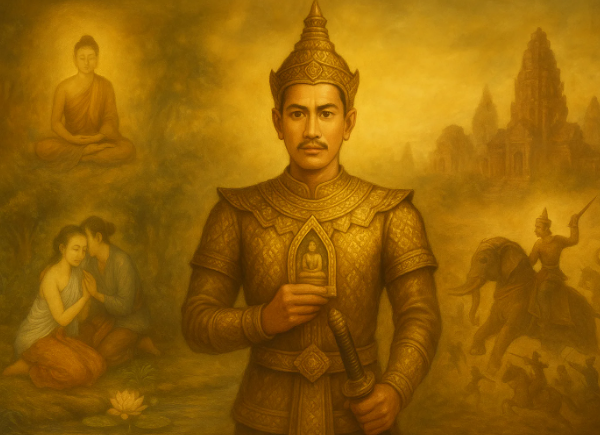
The Epic of Khun Phaen
By Anonymous
Introduction
The Epic of Khun Phaen (Khun Chang Khun Phaen) is often presented as Thailand’s greatest literary tragedy love. It is centered on the protagonist Khun Phaen, the beautiful, brilliant, and perilous hero; Khun Chang, the wealthy, ungainly, and deeply entrenched rival; and Wanthong, the woman whose divided loyalties become the ground on which their conflict is fought. The description is accurate as far as it goes, but it mistakes the narrative’s most visible arrangement for its deepest subject. The epic is centered on the conditions under which desire becomes dangerous - viz. wealth, prestige, force, protection, and access to authority. Wanthong is not merely suspended between two men. She is caught within a world in which attachment is inseparable from household power, property, kinship obligation, masculine rivalry, public reputation, and the unpredictable judgment of rulers.
The larger question of the poem is therefore not simply whom Wanthong loves, nor even which of her suitors deserves her. It is what resources a person can materialize when life is exposed to violence, envy, poverty, erotic competition, political caprice, and misfortune. In a world where neither virtue nor talent offers reliable protection, the epic asks whether knowledge, charisma, power, wealth, and tactical strategy can make a human life less vulnerable to forces it cannot entirely control.
The tale is largely centered on the insecure conditions under which love, wealth, courage, and reputation acquire their value. Within this context, no possession is self-securing. Strength can be defeated by a weapon. Riches depend upon patronage and may evaporate through political disfavor. Beauty invites envy. A household can become a prison. Royal recognition can be revoked as quickly as it is bestowed. Desire itself is unstable, open to persuasion, coercion, seduction, rumor, ritual intervention, and fear.
The supernatural elements of the epic should not then be read as an exotic addition to an otherwise worldly narrative. They belong to the poem’s theory of reality. These elements make visible the conditions that its characters cannot wholly master - viz. contingency, hostile intention, spiritual vulnerability, untimely danger, and the invisible operations of fortune. The arts associated with Khun Phaen do not abolish uncertainty. They offer methods for negotiating it.
Wealth, Charisma, and Dependence
Khun Chang and Khun Phaen represent both divergent modes of morality and worldly power. Khun Chang possesses money, property, kinship connections, household authority, and access to institutions that can convert private desire into public consequence. He is frequently mocked, but ridicule does not diminish his power. His wealth is durable because it is social. It purchases assistance, secures dependents, sustains a household, and makes influence available when character alone would not suffice. Khun Chang’s power resides in structures that endure beyond his person. It lies in property, alliance, family interest, and proximity to authority. He does not need to be heroic to be effective. Indeed, the epic’s severity lies partly in its recognition that social power need not be attractive, virtuous, or brave in order to prevail.
Khun Phaen’s position is more precarious. He possesses the attributes of the epic hero: physical beauty, courage, eloquence, martial ability, sexual magnetism, intelligence, and unusual learning. Yet he lacks the security that would make these gifts straightforwardly advantageous. His father’s execution leaves him exposed to the very political order that should have protected him. He does not enter adulthood with a stable inheritance. He must produce the conditions of his own survival. While Khun Chang possesses resources, Khun Phaen makes himself into one. His learning, speech, bodily presence, weapons, formulas, diagrams, charms, and spirit allies become a private economy of protection. He is, on one hand, a warrior with supernatural accomplishments. On the other hand, he is a specialist in the conversion of vulnerability into advantage. He turns knowledge into force, material objects into safeguards, charisma into influence, and ritual skill into a margin of safety.
The contest over Wanthong thus concerns more than the competing claims of two men. Khun Chang offers material security, property, and the settled authority of the household. Khun Phaen offers beauty, intensity, danger, adventure, and the seduction of extraordinary capacity. Neither form of power leaves Wanthong free from consequence. Her attachments are entangled with household control, family strategy, reputation, political judgment, and physical safety.
The poem understands that desire is never purely private. It is shaped by dependence, status, fear, material need, coercion, and the approval (or opinion) of others.
Effective Knowledge
Khun Phaen’s greatness is acquired through education. His formation begins in the monastery where he learns literacy, languages, calculation, esoteric knowledge, military arts, and ritual disciplines. The body of knowledge associated with him includes mantras, protective formulas, invisibility, spirit-command, techniques of escape, methods of attraction, and the arts of overcoming opposition.
The Thai term wicha is often rendered as “magic,” but the translation is inadequate if it suggests mere fantasy or spectacle. Wicha is effective knowledge. It is knowledge made operational through instruction, discipline, memorization, ritual procedure, embodied practice, and lineage. It does not refer to abstract mastery alone. It refers to learning that can alter the conditions under which a person acts.
The world of Khun Chang Khun Phaen is governed by correspondences. Time possesses quality. Materials retain associations. Speech can act upon the world. Images and diagrams can concentrate intention. A mantra may protect the body, attract a desired response, frustrate an enemy, or open a path that appears closed. A properly prepared object may become more than an object. A spirit may be enlisted as a guide, guardian, messenger, or agent.
Such knowledge does not make Khun Phaen invulnerable. The poem repeatedly refuses the fantasy of perfect security. Its characters remain subject to betrayal, punishment, loss, desire, and political reversal. Yet wicha changes the terms of exposure. It equips Khun Phaen with means of response where another person would possess only courage, desperation, or resignation.
His distinction from Achilles is instructive. Achilles is the supreme warrior, but his greatness is bound to mortality, rage, honor, and irreversible choice. Khun Phaen is formidable in a different register. Like Odysseus, he possesses adaptability, but his intelligence is not confined to strategy or deceit. It is orthopraxic intelligence - viz. a disciplined ability to discern hidden conditions and employ the appropriate means against them.
He does not merely act within the world. He seeks to make the world more favorable to action.For this reason, his knowledge is useful far beyond the battlefield. A complete hero must resist injury, gain entry, evade confinement, attract assistance, lessen hostility, preserve a household, and recognize danger before it takes visible form. Even charm becomes an instrument of survival. The epic does not regard charisma as a superficial personal quality. It treats charisma as a cultivated power to influence the atmosphere of social life.
Fa Fuen and the Materialization of Power
Khun Phaen’s sword -Fa Fuen - belongs to the same economy of force. Its importance lies not simply in its supernatural efficacy but in the manner of its making. The sword is assembled from materials associated with royal authority, religious sites, death, warfare, precious metals, and places of concentrated potency. Metal drawn from palaces and temples, pieces associated with weapons and coffins, and valuable mineral substances are combined through a ritual process of selection, preparation, and invocation. The sword is not forged - it is composed.
Its materials establish a relation between the weapon and the worlds from which those materials have been taken. Palace, temple, battlefield, grave, household, and mine are gathered into one object. The sword becomes powerful because it condenses the social, sacred, and dangerous qualities associated with these domains. It is less a tool than a portable concentration of authority. A comparison with Achilles’ shield is not one of direct equivalence, but it shares some similarity. Achilles’ shield offers an image of the cosmos - viz., conflict and peace, labor and judgment, celebration and death, human society and the surrounding natural order. Khun Phaen’s sword does not depict a world. It incorporates one. It gathers charged materials and ritually converts them into an instrument that may accompany the hero wherever he goes.
The sword is also a form of self-made inheritance. Khun Phaen cannot rely upon the stable protection of a family estate or unbroken political favor. He creates an alternative patrimony. His sword, ritual knowledge, formulas, protective substances, and spirit companions become a movable reserve of force. They are resources that do not depend entirely on household, patron, or court.
This is one reason the epic offers such fertile ground for later amulet traditions. The amulet carries forward the same material imagination on a smaller scale. Sacred efficacy, ritual authority, lineage, memory, and aspiration are concentrated into an object designed to remain near the body. Its power lies partly in its portability. One carries not just an image, but a relation to protection.
Kuman Thong and the Need for Foreknowledge
The Kuman Thong (the “Golden Child") is the most macabre example of Khun Phaen’s effort to extend protection beyond the natural limits of the self. In a well-known version of the epic, Khun Phaen learns that Bua Khli has been instructed by her father to poison him. He kills her, removes the unborn child, and transforms the fetus through ritual acts of drying, consecration, incantation, lacquering, and gilding. The child becomes a spirit companion known as the Kuman Thong. The protagonist transforms death and ritual knowledge into an instrument of protection.
The Kuman Thong is not merely a ghostly attendant. It is an extension of Khun Phaen’s awareness. The golden child warns, scouts, accompanies, and acts in advance of danger. It gives him a presence that can move beyond the boundaries of his own body and perception. The spirit-child embodies a crucial principle of the poem - viz., that survival requires more than the ability to answer a threat once it appears. It requires the possibility of knowing that the threat is coming.
The Kuman Thong can therefore be understood, in modern analytic terms, as a form of distributed agency. It externalizes vigilance. It turns protection into an anticipatory faculty. The hero no longer stands alone before uncertainty; he possesses an auxiliary presence capable of detecting what he cannot yet see.
The Amulet as a Compressed Epic
Add comment
Comments