History of Popular Culture
Part III – General Overview of the City Street
and the Birth of American Amusement Culture
By Anonymous
Having considered the nineteenth‑century street as a crucible of civic life and as an axis of hospitality (and medical architecture), it is now possible to turn to its role in the emergence of modern amusement culture. In the later nineteenth century, the intersection of city streets with institutions of leisure, sociability, and commerce produced new, concentrated spaces of popular experience where public access and commercial spectacle collided. If the American city street functioned as a vessel of assembly, exchange, and contest - it also provided the stage on which urban amusements, commercial entertainments, and new social boundaries were performed and negotiated. By the last quarter of the century, the city had become not only a site of work and struggle but an epicenter of a burgeoning leisure economy that redefined public life through spectacle, novelty, and the simultaneous democratization and privatization of sought leisure.
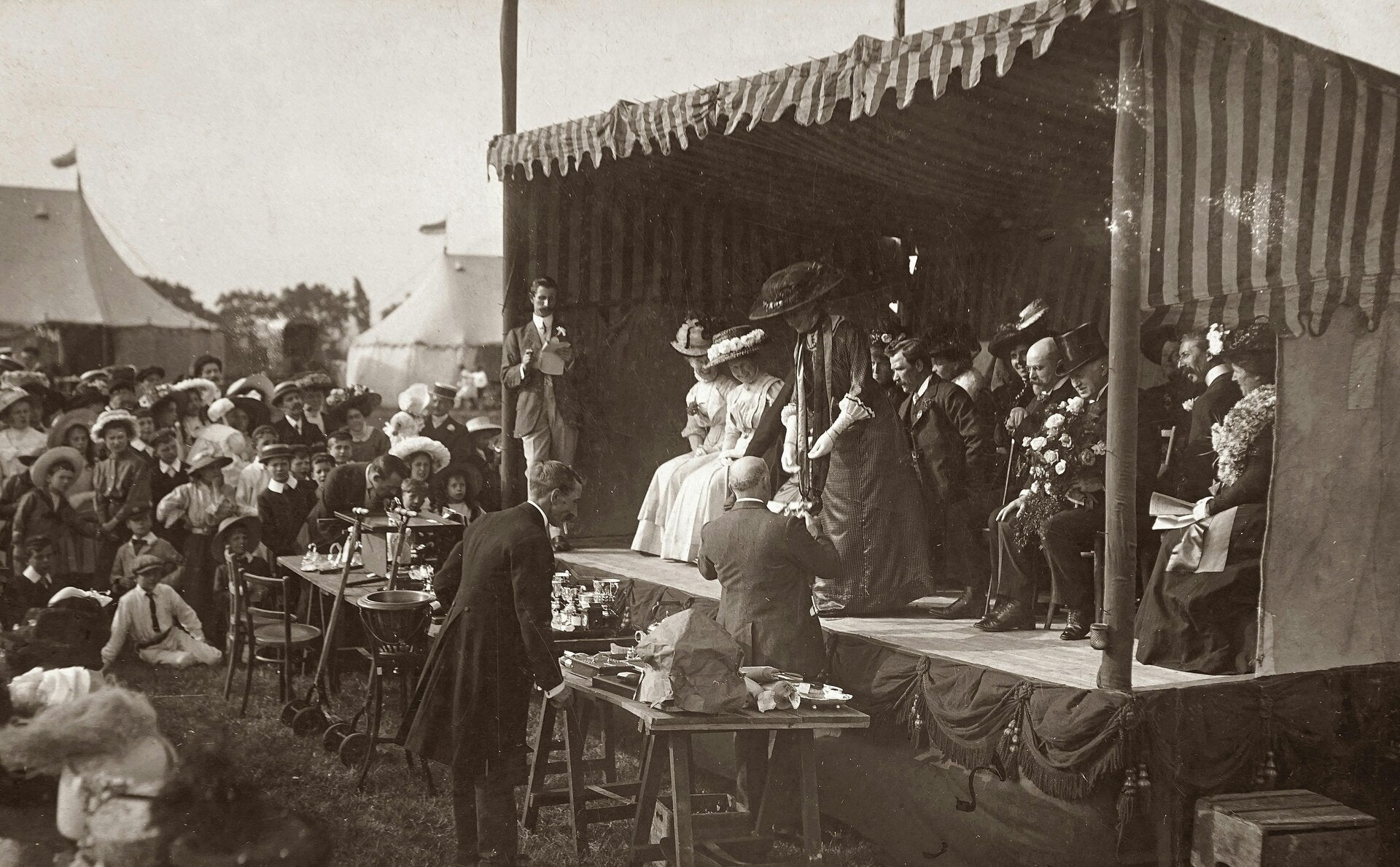
Public entertainments became increasingly visible. Parades, circus processions, and street game tournaments redirected urban flows, unsettled ordinary hierarchies, and transformed thoroughfares into momentary carnivals. Temporary amusements gave way to permanent ones. World’s fairs and expositions embedded new architectural and social ideals within the city. Midways, pavilions, amusement rides, and food stalls were laid out as ostensibly “democratic” spaces that drew together diverse crowds. In practice, they often reproduced and intensified class distinctions through admission prices, dress codes, and spatial separation between promenades meant for the respectable and alleys left to the working poor.
Recreational parks made these tensions especially clear. Reformers envisioned large urban parks as egalitarian lungs for the industrial city, open to all who sought fresh air and moral uplift. In reality, design and regulation frequently favored middle‑class norms. Curving carriage drives and scenic promenades privileged visitors who arrived in vehicles or in appropriate attire. Rules against ball games, loud music, and informal vending limited working‑class uses. When laborers and immigrant communities tried to claim parks for picnics, political rallies, or more boisterous forms of leisure - they were often met with park police and commissions determined to preserve a vision of ordered, quasi‑pastoral repose. The park became a terrain on which competing class cultures of recreation met under unequal conditions.
Commerce also reimagined the street as theater. The rise of the department store, with its plate glass, elaborate displays, and interior arcades, transformed shopping from a utilitarian task into a form of spectacle and social performance. Window‑shopping emerged as a new urban practice that turned sidewalks into galleries of commodity desire. Evening lighting amplified these effects. City lights, illuminated façades, and theatrical marquees lent public space a sheen of glamour and apparent accessibility while deepening anxieties about anonymity, mixed company, and the blurring of class boundaries among those who walked the same illuminated corridors, even if they did not enter the same doors.
For working‑class and immigrant populations, parades and festivals remained sources of both pride and protest. Ethnic processions, labor demonstrations, and outings organized by mutual‑aid societies appropriated the street and the park as sites of belonging even as elite observers worried about disorder, radicalism, and the visibility of “foreign” customs. At the same time, the expansion of mass transit - including electric streetcars, elevated lines, and suburban railways - allowed pleasure‑seekers of different classes to travel outward to parks, racetracks, and, by century’s end, amusement resorts such as Coney Island. These destinations promised escape from urban pressures, yet the journey itself became a laboratory in urban mixing and new codes of conduct, as anonymity and improvisation shaped encounters in crowded cars and along packed promenades.
Street life, once governed primarily by the rhythms of commerce and civic ritual, was altered by entrepreneurial energies and shifting notions of respectability. Urban parks and pleasure gardens - designed as moral correctives to industrial congestion - quickly filled with crowds seeking respite, amusement, and a measure of unregulated sociability. The city’s cultural landscape diversified as beer gardens, ballrooms, variety theaters, and dime museums moved from the margins to become mainstays of working and middle‑class experience. Neighborhoods in the late Nineteenth-Century teemed with saloons that doubled as informal theaters where vaudeville, musical acts, dense audiences, and early moving pictures played too loud. Within these settings, the boundary between everyday street life and organized entertainment grew increasingly thin.
Every expansion of pleasure brought new tensions. The same amusements that opened leisure to the broader public also produced panic about women’s respectability, immigrant vice, juvenile delinquency, and inter‑class mingling. Moral reformers, city planners, and police departments answered with tighter surveillance and efforts to regulate public behavior. The licensing of venues, the policing of gatherings, and the formal zoning of entertainment districts created a new layer of urban administration. Vice squads, blue laws, and restrictive ordinances did not simply respond to disorder. They actively shaped where and how pleasure could be pursued.
These tensions go to the heart of American debates over freedom and propriety, inclusion and exclusion, the commercial and the public. The nineteenth‑century street and its offshoot institutions became a ground on which cultural norms were negotiated alongside pleasures. It was a battleground over who could access joy and under what conditions. In this sense, the trajectory of American popular culture was both produced and constrained by the possibilities and anxieties of the urban street. The history of popular culture in the city can thus be read as a history of negotiations between openness and containment - viz., between spectacle and order - and between the ideal of democratized leisure and the persistent desire to regulate and stratify it. In the decades that followed, the logic of spectacle, mobility, and regulation would extend into dining cars, hash houses, roadside diners, landscaped campuses, and park‑like cemeteries - binding everyday consumption, routine habits, and education more tightly to the spatial forms of popular commodity culture.
Questions for Reflection
The foregoing analysis has outlined how the nineteenth‑century American street evolved from a primarily civic thoroughfare into a dense field of amusement, spectacle, and regulation. It has shown that popular culture did not simply “happen” in theaters, fairs, or parks in isolation. Rather, it emerged through the continual reconfiguration of public space, as commercial entertainments, reform projects, and new infrastructures of mobility which reshaped who could be present, what they could do, and how they were seen. Within this framework, popular culture appears as the lived negotiation between openness and control and the promise of shared pleasure - viz., the persistent sorting of bodies by class, gender, ethnicity, and respectability. Streets, parks, and entertainment districts functioned as platforms of surveillance in which Americans experimented with new forms of leisure and sociability.
Consider the following questions:
- When you think about a city you know best, where do you see the clearest echoes of the nineteenth‑century and early 20th-century street as a space of spectacle and commercialized leisure.
- In your own experience of public space, when have you felt that an environment was genuinely open and shared, and when have you felt that invisible (or visible) rules were sorting people by class, race, respectability, or perceived “fit.”
- How do parks, festivals, shopping districts, or entertainment zones in your city balance invitation and control, and what concrete design features or regulations make this balance visible (consider signage, zoning laws, local boards, and commissions)?
- Looking at a single example, you know well—a park, a downtown block, a fairground, a campus—how might its current uses reflect a longer history of negotiation between democratic access and the desire to manage, refine, or monetize popular pleasure.
Recommended Reading List
John F. Kasson, Amusing the Million: Coney Island
at the Turn of the Century, 1978.
Roy Rosenzweig, Eight Hours for What We Will: Workers and
Leisure in an Industrial City, 1870–1920, 1983.
Kathy Peiss, Cheap Amusements: Working Women and
Leisure in Turn-of-the-Century New York, 1986.
William R. Taylor, ed., Inventing Times Square: Commerce and
Culture at the Crossroads of the World, 1991.
David Nasaw, Going Out: The Rise and Fall of
Public Amusements, 1993.
Gunther Barth, City People: The Rise of Modern City Culture
in Nineteenth-Century America, 1980.
Roy Rosenzweig and Elizabeth Blackmar, The Park and the
People: A History of Central Park, 1992.
Lizabeth Cohen, Making a New Deal: Industrial Workers
in Chicago, 1919–1939, 1990.